

Modern Car Seatbelts: Beyond Restraint – Advanced Active Safety Functions
Modern Car Seatbelts: Beyond Restraint – Advanced Active Safety Functions
Traditional car seatbelts primarily serve as a passive restraint, holding occupants in place during a collision. However, with the integration of automotive electronic technologies, modern seatbelts have evolved into intelligent safety systems featuring warning, pre-judgment and active intervention, whose functions go far beyond simple physical restraint.
One major advancement is the widespread adoption and intelligentization of seatbelt pretensioning. Early pretensioners only activated upon collision. Today, reversible motor-driven pretensioners work in coordination with the Electronic Stability Program (ESP), radar and cameras. When the system (such as Automatic Emergency Braking, AEB) detects a high collision risk before an impact occurs, the pretensioner gently tightens the webbing in advance to eliminate slack, positioning the occupant in the optimal protective posture. It also acts as a tactile alert to warn the driver of potential danger. If the danger passes, the pretensioner automatically releases. This proactive intervention significantly advances the timing of safety protection.
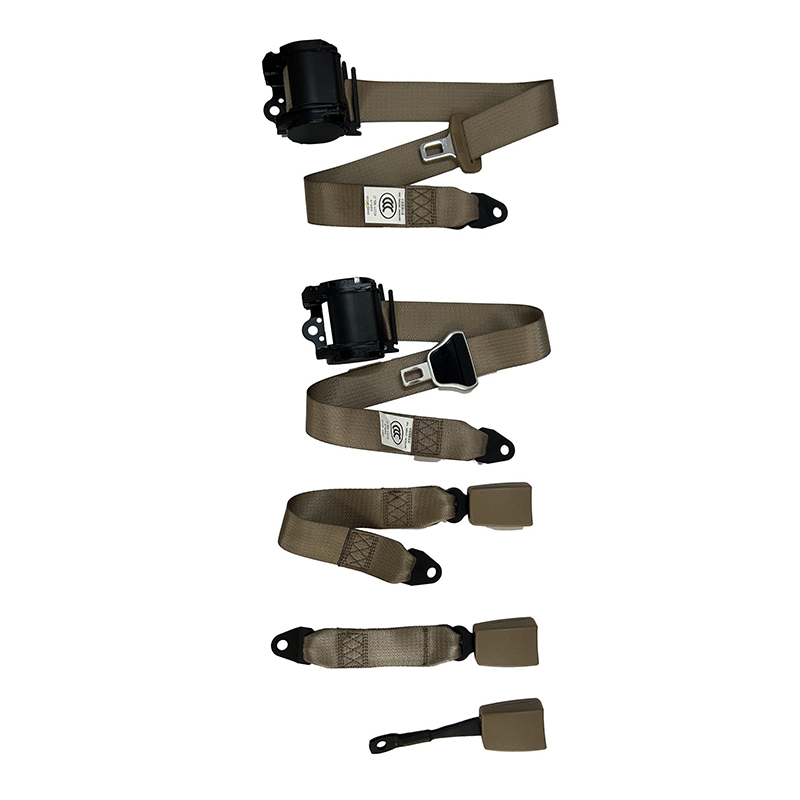
Adaptive force limiting and dual-stage force limiting represent another refined safety feature. Conventional force limiters have a fixed load-releasing threshold. Advanced systems dynamically adjust the force-limiting level based on collision severity, occupant size (detected via seat sensors) and seat position. In moderate collisions, they provide stronger restraint to control body movement; in severe high-speed crashes, they release the webbing earlier and more gently to optimize chest load distribution. This marks a shift from standardized protection to personalized, adaptive protection.
Integrated seatbelt reminder and warning systems are becoming more intelligent and cabin-wide. Modern systems not only monitor seatbelt use in the front seats but also track each rear seating position via pressure sensors or sensors built into the buckle. More advanced systems link with door and ignition logic: if rear passengers fail to fasten seatbelts, the dashboard displays targeted warnings, accompanied by audible alerts or in-car screen prompts. Some models even prevent shifting into drive or issue continuous warnings until all rear seatbelts are fastened, enforcing proper usage throughout the vehicle.
Looking ahead, car seatbelts will be deeply integrated with in-cabin intelligent monitoring systems. For instance, vital sign sensors woven into the webbing can monitor the driver’s heart rate and respiratory rate to detect fatigue or sudden health issues. Seatbelts may also serve as sensors to verify proper installation of child safety seats. In autonomous driving scenarios, they could evolve into airbag-integrated seatbelts or full-range restraint systems, providing dynamic lateral and shoulder support during aggressive autonomous evasive maneuvers. Clearly, the modern seatbelt has transformed from a mechanical component into an intelligent safety node that perceives, calculates and executes protective commands.
Send Inquiry



X
We use cookies to offer you a better browsing experience, analyze site traffic and personalize content. By using this site, you agree to our use of cookies.
Privacy Policy