

What Links Does the Product Aging Test of Safety Belt Manufacturers Go Through?
What Links Does the Product Aging Test of Safety Belt Manufacturers Go Through?
Safety belts are important protective equipment that needs to maintain reliable performance for a long time in various environments. To ensure that the safety belt can still play an effective protective role during its service life, safety belt manufacturers must conduct strict aging tests on their products before leaving the factory. The aging test is an important part of the safety belt quality control process, which simulates the various environments and usage conditions that the safety belt may encounter during its service life, and tests the durability and stability of the product. This article will detail the specific links of the product aging test of safety belt manufacturers, revealing how manufacturers ensure that the safety belt can maintain reliable performance during its service life.
First of all, the pre-test preparation link is the foundation of the aging test. Before conducting the aging test, safety belt manufacturers will select representative samples from each batch of products. The samples must be consistent with the formal products in terms of materials, production processes, and structural design to ensure the representativeness and accuracy of the test results. At the same time, the manufacturer will conduct initial performance tests on the samples, including tensile strength, stitching firmness, retractor locking sensitivity, and color fastness, and record the initial data as a reference for subsequent aging test comparisons. In addition, the test equipment will be inspected and calibrated to ensure that the parameters of the equipment are accurate and stable, and the test environment meets the standard requirements, avoiding test errors caused by equipment failure or environmental deviation.
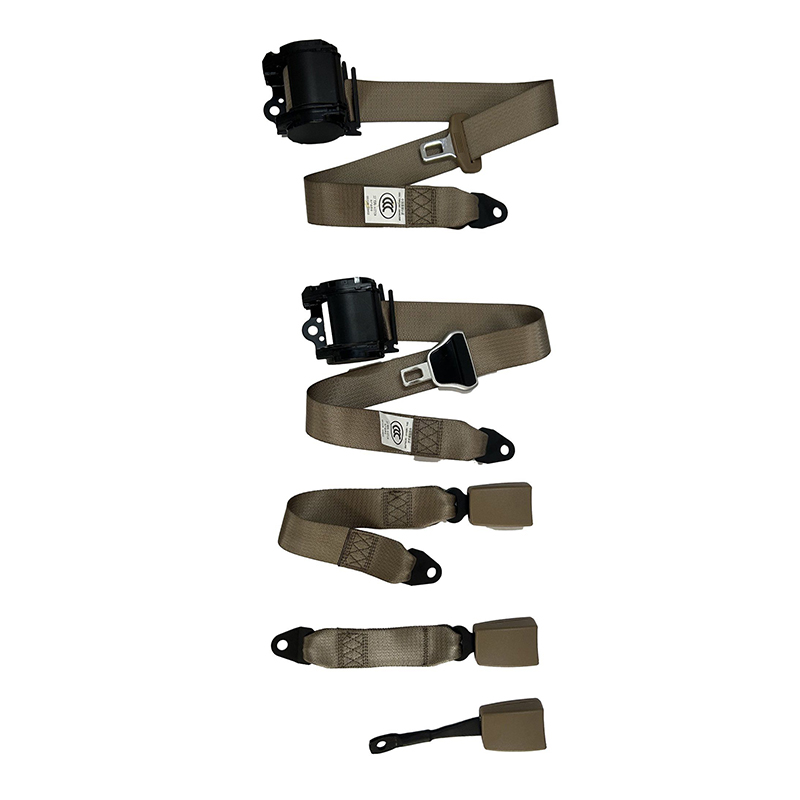
Secondly, the environmental aging test link simulates the natural aging process of the safety belt in actual use. This link mainly includes several common environmental simulation tests, each of which targets different environmental factors that affect the safety belt. The first is the high-temperature aging test: the safety belt sample is placed in a high-temperature test chamber, and the temperature is set to 60-80℃ (simulating the high temperature inside the car in summer or the high temperature environment of industrial sites), and the sample is kept for 1000-2000 hours. During the test, the changes of the sample, such as webbing brittleness, thread aging, and component deformation, are regularly observed and recorded. The second is the damp-heat aging test: the test chamber is set to a temperature of 40-50℃ and a humidity of 80%-90% (simulating the humid environment in the south or the rainy season), and the sample is placed for 800-1500 hours to test the corrosion resistance and moisture resistance of the safety belt, especially the performance changes of the retractor, buckle, and other metal components. The third is the ultraviolet (UV) aging test: the sample is irradiated with UV lamps simulating sunlight, and the irradiation time is 500-1000 hours, to test the light fastness of the webbing and the aging resistance of the material, avoiding the webbing fading, brittleness, and strength reduction caused by long-term exposure to sunlight. In addition, for industrial safety belts, manufacturers will also conduct chemical corrosion aging tests, simulating the corrosion of chemical substances such as acid and alkali in industrial sites on the safety belt, to ensure that the product can maintain performance in harsh chemical environments.
Thirdly, the mechanical aging test link simulates the fatigue damage caused by repeated use of the safety belt. Safety belts are used repeatedly during their service life, so mechanical aging is an important factor affecting their service life. This link mainly includes two core tests: the first is the webbing repeated pulling test. The webbing is fixed on a tensile testing machine, and repeated pulling and retracting operations are performed (simulating the process of the occupant buckling and unbuckling the safety belt), with a pulling frequency of 10-20 times per minute and a total number of times of 10,000-50,000 times. During the test, the tensile strength of the webbing and the firmness of the stitching are regularly detected to check whether there is thread loosening, stitching wear, or webbing deformation. The second is the retractor fatigue test: the retractor is fixed on the test equipment, and repeated retraction and locking operations are performed, simulating the retraction and locking process of the safety belt during normal use and emergency situations. The test frequency is 5-10 times per minute, and the total number of times is 5,000-20,000 times. The test focuses on checking whether the retractor has unsmooth retraction, delayed locking, or failure to lock, and whether the internal components are worn or damaged. For automobile safety belts, manufacturers will also add a pre-tensioner and force limiter fatigue test, simulating the working state of these components in multiple emergency situations, to ensure that they can still work normally after long-term use.
Fourthly, the post-aging performance test link is used to evaluate the performance degradation of the safety belt after aging. After the environmental aging and mechanical aging tests are completed, the manufacturer will conduct the same performance tests on the aged samples as the pre-test, including tensile strength, stitching firmness, retractor locking sensitivity, color fastness, and component functionality. By comparing the post-aging test data with the initial data, the performance degradation degree of the safety belt is evaluated. If the performance degradation exceeds the allowable range (for example, the tensile strength of the webbing decreases by more than 20%, or the retractor fails to lock normally), the batch of products will be rejected or reprocessed. Only the samples that meet the performance requirements after aging can pass the test, and the corresponding batch of products can leave the factory.
In addition, the test data recording and analysis link is an important part of the aging test. Throughout the entire aging test process, manufacturers will record all test data in detail, including test environment parameters, test time, sample performance changes, and post-aging test results. These data are sorted and analyzed to find out the weak links of the product in the aging process, optimize the product materials and production processes, and improve the aging resistance of the safety belt. At the same time, the test data can also be used as a basis for product quality tracing, which is convenient for recalling and handling unqualified products in time if quality problems occur in the later stage.
It is worth noting that the aging test of safety belt products must comply with national and international standards, such as the European EN standard, the American FMVSS standard, and the Chinese GB standard. The test methods, test parameters, and evaluation indicators are strictly in accordance with the standard requirements to ensure the authority and comparability of the test results. In addition, with the continuous development of technology, safety belt manufacturers will also introduce more advanced aging test equipment and methods, such as accelerated aging tests, which can shorten the test cycle while ensuring the accuracy of the test results, improving the efficiency of product quality control.
In conclusion, the product aging test of safety belt manufacturers is a systematic and rigorous process, which includes pre-test preparation, environmental aging test, mechanical aging test, post-aging performance test, and test data recording and analysis. Through these links, manufacturers can fully simulate the aging process of the safety belt in actual use, test the durability and stability of the product, and ensure that the safety belt can maintain reliable performance during its service life. The strict aging test is an important guarantee for the quality of safety belts, which can effectively avoid safety accidents caused by product aging and protect the lives of users.
Send Inquiry



X
We use cookies to offer you a better browsing experience, analyze site traffic and personalize content. By using this site, you agree to our use of cookies.
Privacy Policy