

What Special Requirements Do the Production Equipment of High-Quality Safety Belt Manufacturers Have?
What Special Requirements Do the Production Equipment of High-Quality Safety Belt Manufacturers Have?
The quality of safety belts directly relates to human life, and the production equipment is the foundation for ensuring the quality of safety belts. High-quality safety belt manufacturers must have advanced, precise, and stable production equipment, which not only can improve production efficiency but also can ensure the consistency and reliability of product quality. Compared with ordinary safety belt manufacturers, the production equipment of high-quality safety belt manufacturers has more special requirements, covering the entire production process from raw material processing, webbing weaving, dyeing, sewing, to final assembly and testing. This article will detail the special requirements of the production equipment of high-quality safety belt manufacturers, helping to understand the hardware strength behind high-quality safety belts.
First of all, the webbing weaving equipment has strict requirements. The webbing is the core part of the safety belt, which requires high tensile strength, wear resistance, and uniformity. High-quality safety belt manufacturers use high-speed rapier looms or air-jet looms for webbing weaving, which have the characteristics of high weaving speed, high precision, and stable performance. The weaving speed of these looms can reach 300-500 rpm, which not only improves production efficiency but also ensures that the weft and warp of the webbing are evenly arranged, and the density is consistent. In addition, the weaving equipment is equipped with an automatic tension control system, which can accurately control the tension of the warp and weft during the weaving process, avoiding the webbing from being too tight or too loose, and ensuring that the tensile strength of the webbing meets the standard. The weaving equipment also has an automatic defect detection function, which can detect defects such as broken threads, missing threads, and uneven density in the webbing in real time, and automatically stop the machine for processing, avoiding unqualified webbing from entering the next process.
Secondly, the dyeing equipment has special requirements for precision and stability. The color consistency and color fastness of the webbing are important indicators of safety belt quality, which are closely related to the performance of the dyeing equipment. High-quality safety belt manufacturers use automatic continuous dyeing machines, which can realize continuous dyeing of the webbing, ensuring that the dyeing time, temperature, and dye concentration of each section of the webbing are consistent. The dyeing machine is equipped with a precise temperature control system, which can control the dyeing temperature within ±1℃, avoiding color differences caused by temperature fluctuations. In addition, the dyeing machine is equipped with a circulating filtration system, which can filter the dye solution in real time, remove impurities in the dye solution, and ensure that the dye is evenly distributed, avoiding uneven dyeing of the webbing. After dyeing, the webbing is dried by an automatic drying machine, which has a uniform air supply and temperature control, ensuring that the webbing is dried evenly and the color does not fade.
Thirdly, the sewing equipment has high requirements for precision and durability. The sewing process is the key link that determines the load-bearing capacity and service life of the safety belt, so the sewing equipment must have high precision and stability. High-quality safety belt manufacturers use high-speed computerized sewing machines, which have the characteristics of high sewing speed, precise stitching, and stable performance. The sewing speed of these sewing machines can reach 2000-3000 stitches per minute, and the stitching density can be adjusted accurately (usually 10-12 stitches per inch), ensuring that each stitch is even and tight. The sewing machine is equipped with an automatic thread trimming system and an automatic needle position adjustment system, which can improve sewing efficiency and avoid stitching defects such as thread breakage and missing stitches. In addition, the sewing machine uses high-hardness needles and high-strength threads, which can withstand the high tension during sewing and ensure the durability of the stitching.
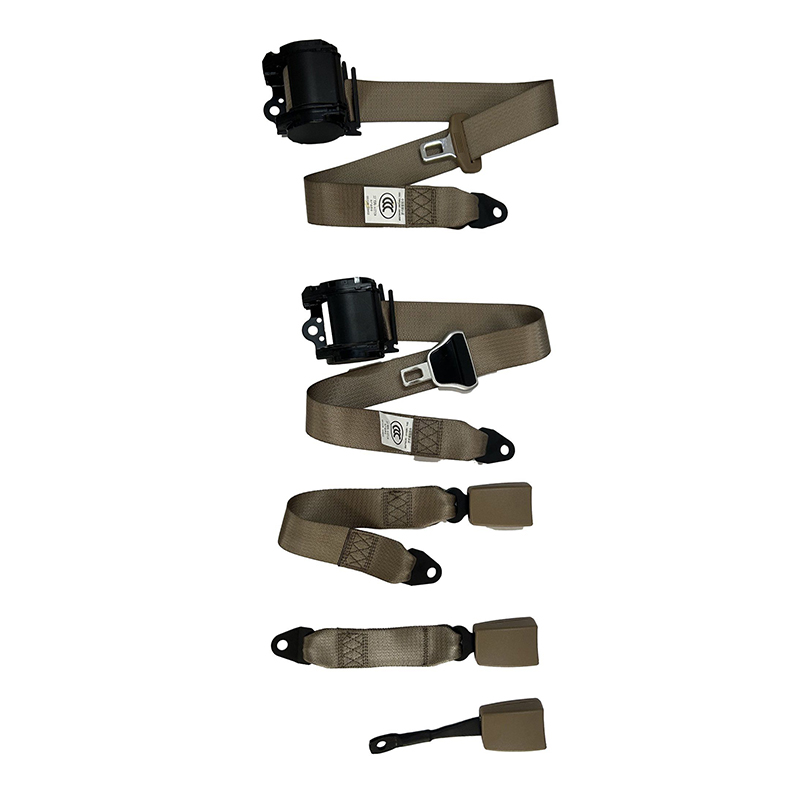
Fourthly, the assembly and testing equipment has strict requirements for accuracy and comprehensiveness. After the webbing is sewn, it needs to be assembled with components such as the retractor, buckle, and force limiter to form a complete safety belt. High-quality safety belt manufacturers use automatic assembly equipment, which can realize the automatic assembly of each component, ensuring that the assembly position is accurate and the connection is firm. The assembly equipment is equipped with an automatic detection system, which can detect whether the assembly is in place, whether the buckle can be locked and released normally, and whether the retractor can retract and lock smoothly. In addition, the safety belt must undergo strict testing before leaving the factory, so high-quality safety belt manufacturers are equipped with a variety of professional testing equipment, including webbing tensile testing machines, retractor locking testing machines, force limiter performance testing machines, and color fastness testing machines. These testing equipment can accurately detect various performance indicators of the safety belt, ensuring that each safety belt meets the national and international standards.
In addition, the production equipment of high-quality safety belt manufacturers also has requirements for automation and intelligence. Modern high-quality safety belt manufacturers adopt automated production lines, which can realize the integration of webbing weaving, dyeing, sewing, assembly, and testing, reducing manual operation, improving production efficiency, and avoiding human errors. The production line is equipped with an intelligent monitoring system, which can monitor the operation status of each equipment in real time, collect production data, and adjust the production parameters in time to ensure the stability of product quality. At the same time, the equipment is regularly maintained and calibrated by professional technicians to ensure that the performance of the equipment is stable and the accuracy meets the requirements.
It is worth noting that the production equipment of high-quality safety belt manufacturers must comply with relevant national and international standards, and the equipment must be tested and certified by professional institutions before it can be put into use. In addition, manufacturers will also continuously update and upgrade the production equipment, introducing advanced technology and equipment to improve product quality and production efficiency.
In conclusion, the production equipment of high-quality safety belt manufacturers has special requirements in terms of precision, stability, automation, and comprehensiveness, covering the entire production process of safety belts. These special requirements ensure that the safety belts produced have high tensile strength, good durability, consistent color, and reliable performance, providing effective protection for the lives of users. Choosing safety belts produced by manufacturers with advanced production equipment is an important guarantee for safety.
Send Inquiry



X
We use cookies to offer you a better browsing experience, analyze site traffic and personalize content. By using this site, you agree to our use of cookies.
Privacy Policy